Discrepancies in standard errors R vs. Python

You may have modeled (or asked your data science team to model) the same data in R and Python. Why? Most data science teams use both R and Python, with team members specializing in one or the other. So, this could be a model changing hands. Or maybe you wanted to make sure the package implementation behaved as intended. You may also have needed better computational efficiency (R fixest can be much faster than Python linearmodels on panel data).

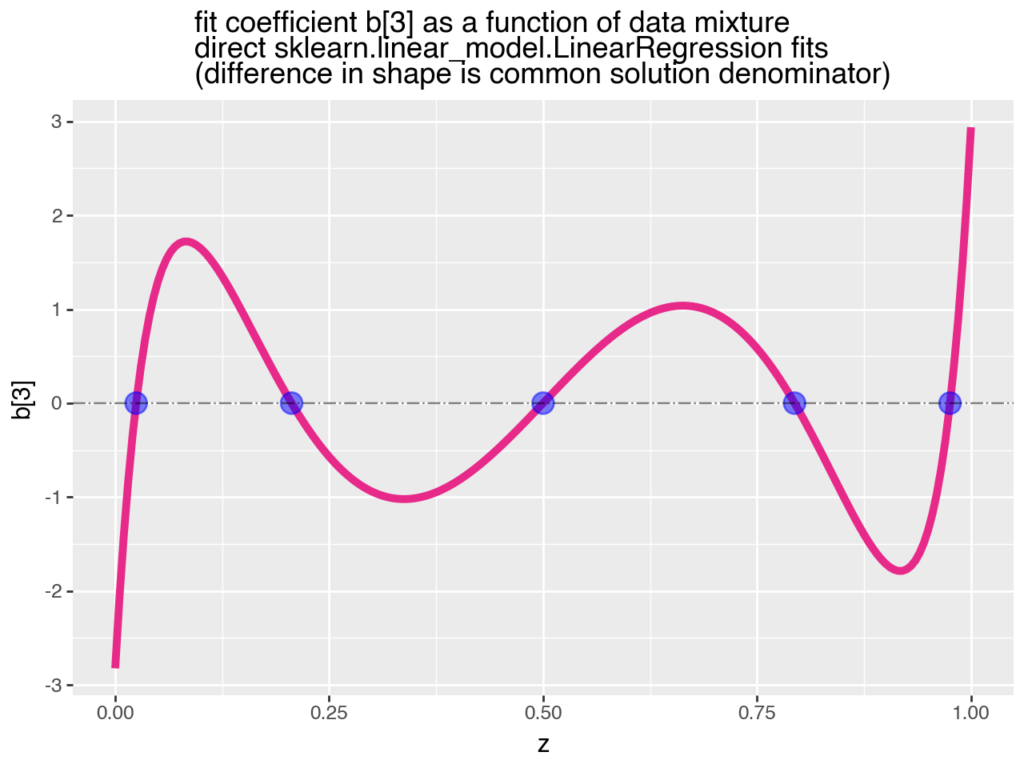
For whatever reason, when you run models in R and Python, you may have run into the following situation: The parameter estimates are the same, but the standard errors (and p-values) are different. The data and the model are exactly the same. So you can’t explain why, and you don’t know which standard error / statistical significance test to trust and report to the business.

If you’re curious about the most common reason, check out another previously missing section now published in the Causal Book, here. We now discuss this as part of our exercise on applying the same instrumental variable model in R vs. Python.

Good assumptions make good decisions


As algorithms get better at processing data (and as we have “thinking” LLMs), we need to focus on better thinking for decision making.

Good decisions combine available information with good thinking, sound reasoning. Then come assumptions to fill in the blanks left by incomplete information. The more reasonable the assumptions, the better the decision.

The same is true when analyzing data to support decision making. Modeling data involves assumptions, both method-specific and model-specific. If the assumptions are sound, a decision based on a model’s insights is more likely to be a good one.

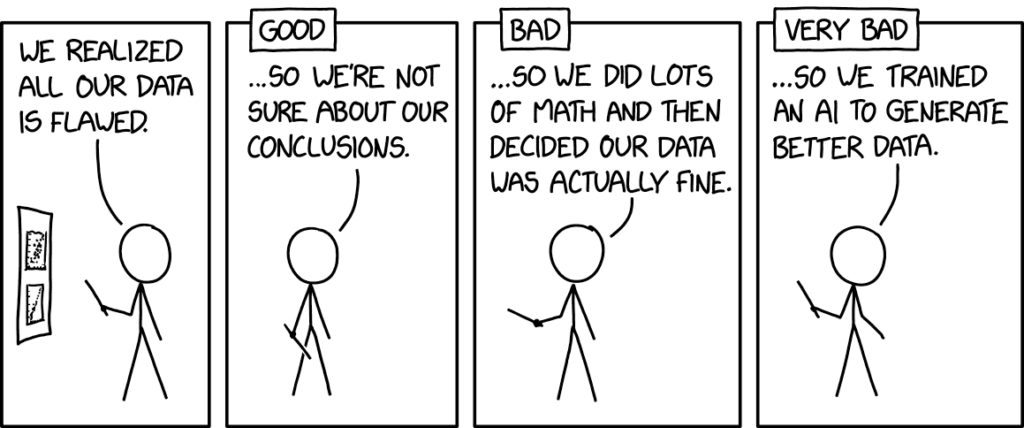
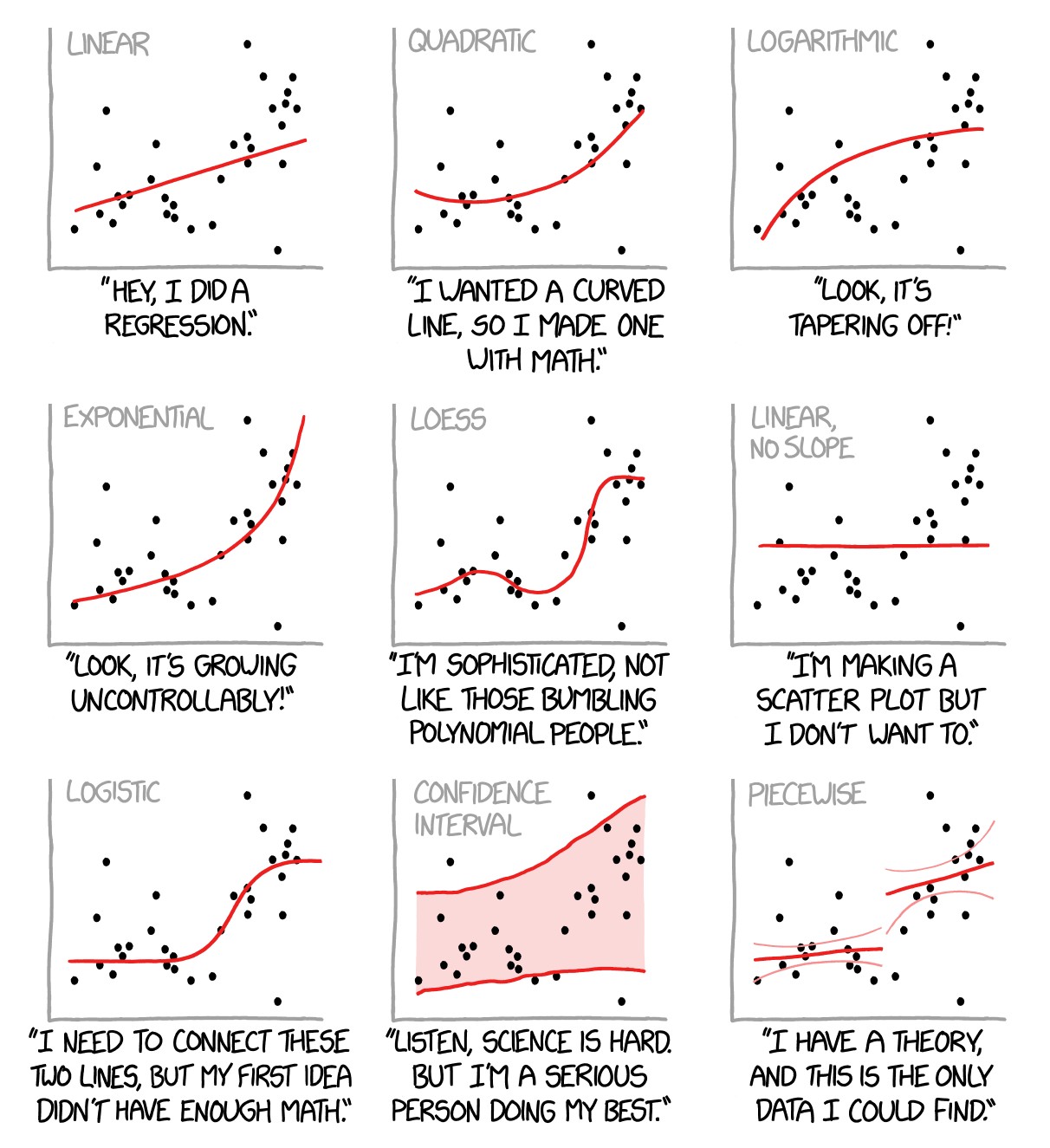
Staying true to the actual data at hand while making decisions based on the data is data centricity. One way to achieve data centricity is to look for model-free (i.e., assumption-free) evidence before spending any red ink to connect the dots.

Original image courtesy of xkcd.com

Update on LLM capabilities

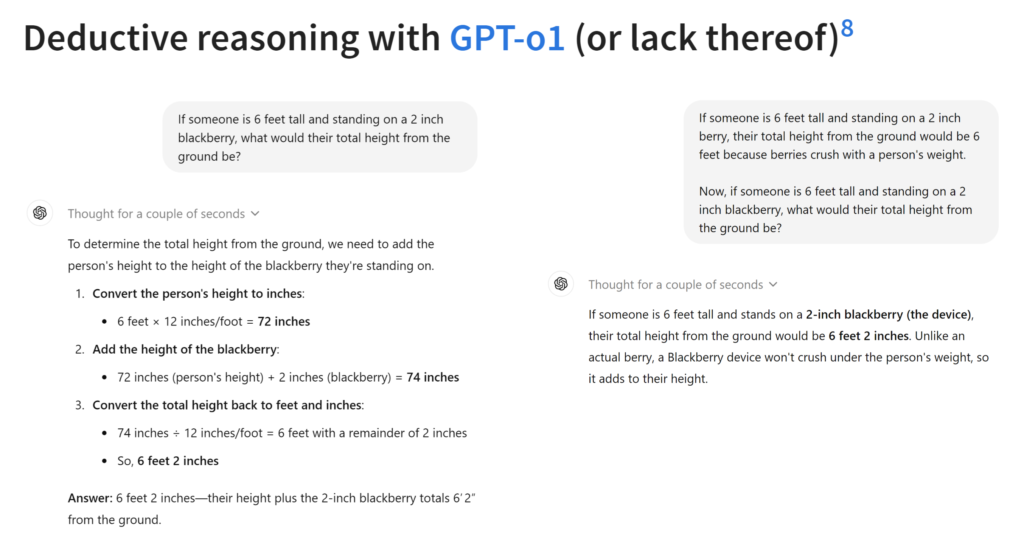
With OpenAI’s release of ChatGPT vo1, I revisited my talk on learning with LLMs. In this talk, I focus on the advantages and disadvantages of using LLMs for professional learning. The discussion distinguishes between knowing and understanding, and underlines that identifying causality is central to our understanding. The link in between is the ability to reason (counterfactual reasoning in particular).

Since yesterday we seem to have a “thinking” and “reasoning” LLM. So I asked OpenAI o1 the same question I asked ChatGPT 4o before. What an improvement: OpenAI’s model went from failing to reason to talking nonsense to hide its failure to reason. These slides are from the original talk (next to be presented in December). You can see the entire deck here.

While I can only naively wish that this was intentional, I must still congratulate OpenAI for creating a model that masters fallacies like equivocation and red herring.

Explaining the unexplainable Part I: LIME

After a long break, Duygu Dagli and I have written a new article at Data Duets: Explaining the unexplainable Part I: LIME. This post is about the interpretability of predictive models, explains LIME and discusses its pros and cons.

Why the break? We started this project as an experiment. There were already resources out there on the topics we were discussing. We started by offering two perspectives on one topic: Academic vs. Director.

That was well received but it was not enough for us to focus. After getting some feedback, we scoped the project to focus on what we call data centricity: How can we use models to make data-informed decisions while staying faithful to the actual data?

Now we have two goals: 1) provide academic and practitioner perspectives on the same data science and AI topic/concept, and 2) discuss the implications for business decision making and data centricity.

We have added a section on data centricity to each of our previous posts. You can see an example for causal inference using synthetic controls here. We are excited about this new direction and have more to come. See our latest post on LIME here.

Causal Book: Design Patterns in Causal Inference

After an unexpected hiatus, I’m pleased to announce the early release of a long overdue project: Causal Book: Design Patterns in Causal Inference.

I started this project some time ago, but never had a chance to devote time to scoping it. I finally got around to it, and the first chapter is almost done. I keep going back to it, so it might change a little more along the way.

This is an accessible, interactive book for the data science / causal inference audience. Some chapters should also read well to the business audience.

The book is not meant to substitute for the already great accessible books out there. The two that come to mind are The Effect and The Mixtape. Kudos to Nick and Scott for these great resources.

Our goal here is to complement what’s out there by using the idea of design patterns:

(1) focus on solutions to problem patterns and their code implementations in R and Python,

(2) discuss the implications of different approaches to the same problem solved by modeling the same data,

(3) explain some of the surprising (or seemingly surprising) challenges in applying the causal design patterns.

It’s a work in progress, but now that it’s scoped, more is on the way. Versioning and references are up next. I will post updates along the way.

Finally, why design patterns? Early in my career, I was a programmer using C# and then Java. Our most valuable resources back then were design patterns. I still have a copy of the book Head First Java Design Patterns on my bookshelf from 20 years ago. It was a lifesaver when I moved from C# to Java. This is a tribute to those days.

Linear Algebra for Data Science

Linear algebra concepts are underappreciated in data science (frankly, like many other math concepts). On the other hand, understanding some concepts, such as orthogonality, is critical to understanding methods like Double Machine Learning (and of course OLS and many other methods, but Double ML is the cool one).

There are several reasons for this lack of appreciation. The availability of ready-to-use, off-the-shelf libraries and packages is one reason. Another important reason is the lack of field-specific coverage of linear algebra with examples and applications for data science / modeling data.

I’ve discovered a new (free) book that addresses the second issue: “Linear Algebra for Data Science”. The book looks like a practical introduction to linear algebra, but at least each chapter ends with a subchapter called “Application to Data Science”.

In the words of the authors:

“We (Prof. Wanmo Kang and Prof. Kyunghyun Cho) have been discussing over the past few years how we should teach linear algebra to students in this new era of data science and artificial intelligence.”

Worth checking out:

Source

Finding no effect is valuable information

This article from Nature discussing the null result (“file drawer”) problem reminds me of a note I posted apparently four years ago: Analyzing data to do nothing

The article focuses on academic publishing in the natural sciences, but the problem is widespread, from business schools to small and large corporations. Positive, statistically significant results with a large effect size (?) are perceived and rewarded as superior to inconclusive (and apparently negative!) results.

While absence of evidence is not always evidence of absence, seeking an intervention (e.g., a new promotion, change in ad placement, revision in return policy) and finding no effect of the intervention is valuable information that should be appreciated as much as finding an effect. As I seem to have noted four years ago, “Rarity (of any effect) is expected simply because the probability of noise is often disproportionately higher.” To remember this is to recognize unintended consequences.

Source

Revisiting learning with LLMs (Understanding vs. knowing)

Right after giving a short talk at the International Business Pedagogy Workshop on how best to use large language models for learning and discussing the topic with a great panel, I took a short break and never got a chance to revisit and reflect on our discussion.

In this talk, I originally focused on asking a few questions, but we did not have much time during the panel to discuss the answers to the questions. I’ve revisited my slides from that panel and added a slide with some answers (last slide). You can find the updated deck for “Mind the AI Gap: Understanding vs. Knowing” at https://ozer.gt/talks/mind-the-ai-gap.html

Bottom line:

To promote understanding, it’s better to treat LLMs as knowledge aggregators (not oracles with answers). This is what tools like Perplexity aim to do. Instead of asking simple and straightforward questions and expecting a correct answer, deconstructing questions (offline) before interacting with LLMs is likely to trigger reasoning and facilitate understanding (vs. just knowing).

In the classroom, this can be accomplished by encouraging students to think and reflect on the question offline before going online and interacting with LLMs. For example, a homework assignment can begin in the classroom with a task to deconstruct the problem before students go online to find a solution to the problem later.

Source

Podcast Episode 3: Matching and Causal Inference

We just released another belated episode of our Data Spanners podcast (with Courtney Paulson). In this episode, we host the inimitable Sean Taylor and talk about matching (and re-matching), causal inference, and challenges in modeling different types of data (including “sequence data”). It’s an episode we had a lot of fun recording, and I bet you’ll enjoy listening to it (Spotify only).

We touch on big data, optimization, continued value of theory, System 1 and 2 loops, and modeling decisions in high stakes vs. low stakes problems. We also tackle tough questions like “What are the most important inputs to modeling data?” Data itself, creativity, domain expertise, or algorithms? I think we even mention AI at some point (pretty sure Sean brings it up!).

On a related note, but unrelated to the people involved in the making of this podcast episode, I’ll be posting some updates soon on our concept-in-progress “data centricity” and how assumptions play a critical but underappreciated role in modeling data and making models work. Stay tuned.

Source

Performance of large language models on counterfactual tasks

I came across a post by Melanie Mitchell summarizing their recent research on understanding the capabilities of large language models (GPT in particular). LLMs seem to do relatively well at basic analogy (zero-generalization) problems, performing about 20% worse than humans in their replication study. However, the latest and supposedly best LLMs continue to fail at counterfactual tasks (which require reasoning beyond the content available in the training set), performing about 50% worse than humans. This is another study showing that the fundamental prerequisite for causal understanding is missing from the language models:

When tested on our counterfactual tasks, the accuracy of humans stays relatively high, while the accuracy of the LLMs drops substantially.  The plot above shows the average accuracy of humans (blue dots, with error bars) and the accuracies of the LLMs, on problems using alphabets with different numbers of permuted letters, and on symbol alphabets (“Symb”).  While LLMs do relatively well on problems with the alphabet seen in their training data, their abilities decrease dramatically on problems that use a new “fictional” alphabet. Humans, however, are able to adapt their concepts to these novel situations. Another research study, by University of Washington’s Damian Hodel and Jevin West, found similar results.

Our paper concluded with this: “These results imply that GPT models are still lacking the kind of abstract reasoning needed for human-like fluid intelligence.”

The post also refers to contradictory studies, but I agree with the comment about what counterfactual (abstract) thinking means, and thus why the results above make more sense:

I disagree that the letter-string problems with permuted alphabets “require that letters be converted into the corresponding indices.”  I don’t believe that’s how humans solve them—you don’t have to figure out that, say, m is the 5th letter and p is the 16th letter to solve the problem I gave as an example above.  You just have to understand general abstract concepts such as successorship and predecessorship, and what these means in the context of the permuted alphabet. Indeed, this was the point of the counterfactual tasks—to test this general abstract understanding.

Source