When to normalize / apply weights

To me, this is interesting not because of the lack of transparency in methodology but the potential reason for the rankings to be wrong.

I want to believe that this is a mistake not fraud, but really? Applying the weights before normalizing the scores? And the Bloomberg Businessweek spokesperson says “the magazine’s methodology was vetted by multiple data scientists.”

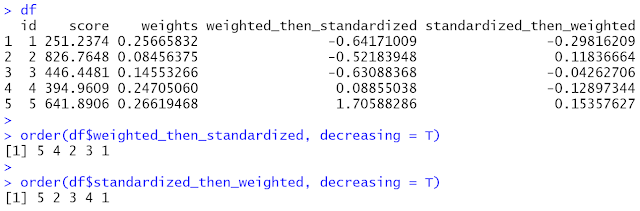
I have created a quick scenario as a reminder to my former (and current) students (posted in the comments as LinkedIn doesn’t allow here). In the example, the scores are standardized across the five items (which are randomly generated and assigned weights). In the Businessweek rankings, standardization is supposed to be across institutions so that the weights proportionately affect each institution’s score on the corresponding item. Nevertheless, the source of the error is the same. If the weights are applied before normalizing the data, the scores are adjusted by the weights disproportionately. Ranking changes accordingly.
Algorithmic fashioning

For years, Zara has been my go-to case to discuss data centricity in fashion retail. Zara is a staple example of how a focus on data and analytics combined with the right, complementary business processes can create wonders even in a market with high degrees of demand uncertainty due to the hedonic nature of consumption.

Shein seems to be emerging as a contender, moving further into data-driven (not only data-informed) fast fashion. Its operation is also called real-time fashion rather than fast fashion. Shein doesn’t own any physical stores (none at all) and ships all of its products directly from China.

Bloomberg reports that “Shein has developed proprietary technology that harvests customers’ search data from the app and shares it with suppliers, to help guide decisions about design, capacity and production. It generates recommendations for raw materials and where to buy them, and gives suppliers access to a deep database of designs for inspiration.”

Shein reduces the design to customer turnaround to 10 days, a record compared to already-fast Zara’s two- to three-week lead time. It’s not a niche operation either, given the reports of a $10 billion annual sales and a potential $30 billion valuation.

I’ve found the whole story interesting. It all sounds impressive but also dangerous. The article already mentions some of the “accidents” its algorithm-driven fashion caused along with sustainability concerns.

“But it would be naïve to predict that unpredictable events won’t happen in the future.”

“Zillow Quits Home-Flipping Business, Cites Inability to Forecast Prices,” WSJ reports.* I try to avoid passing along news stories but it’s not everyday I receive a predictive analytics story as breaking news.

I wonder whether the reason is really “an inability to forecast the prices” or “relying too much on an ability to forecast the prices” for a “$20 billion a year” venture as it was debuted.

Zillow announced plans for this data-driven venture in 2018 by citing consumers who “expect magic to happen with a simple push of a button.” In a statement yesterday, Zillow seems to have realized magic is not happening: “But it would be naïve to predict that unpredictable events won’t happen in the future.”

Maybe it is never a good idea to develop a whole business model that grossly underestimates the changes in error (both reducible and irreducible) due to potential bifurcations in market forces.

Source

If tech is everything, then it is nothing

What do #Facebook, #Tesla, #DoorDash, #Nvidia, and #GM* have in common? They are all “tech” companies.

Alex Webb of Bloomberg offers a linguistic explanation for why technology ceased to be meaningful:

“English lacked an equivalent to the French technique and German Technik. The English word “technique” hadn’t caught up with the innovations of the Industrial Revolution, and it still applied solely to the way in which an artist or artisan performed a skill.”

He contrasts technique as in “artistic technique” in English with technique as in “Lufthansa Technik” in German and argues that technology emerged in the early 20th century for the lack of a better alternative.

Whether the reason is linguistic, sheer overhype, or semantic satiation, we may be better off dropping the “tech company” reference at this point unless it is elaborated further. For the companies that are more tech than your average tech, a good alternative may be “deep tech.”

Data-driven paralysis

Data-driven decision making can lead to paralysis. Last week, the FDA and CDC committees couldn’t make a decision about the booster shots because (complete) data was not available. Well, making decisions in the absence of complete data is a process of imagination and deep thinking, one that puts hypothesis development at the center and humans continue to prevail over machines in the process.

To avoid such a paralysis, more focus can be put on developing and rethinking hypotheses and their likelihoods. In emergent problems, an in-depth discussion on hypotheses and likelihoods is probably more helpful than an obsession to access complete data. Otherwise, by defining complete data as a prerequisite, as it would be in data-driven decision making, we will continue to be paralyzed looking into the future.

If we turn to data-informed decision making, however, hypotheses would take more control (not gut feeling but properly developed hypotheses*). We could then make decisions to be improved as more data becomes available without being paralyzed in the present. Rather than seeking the truth, we would seek probable truths (as in Bayesian thinking).

While we may be able to remain strictly data-driven for some problems and decisions, we should be comfortable proceeding informed (not driven) by data for others.

* This post made me think of a book I enjoyed reading last Fall: Defense of the Scientific Hypothesis: From Reproducibility Crisis to Big Data

To log or how to log

I avoid posting technical notes here. This is an exception because I have an agenda.

Log transformation is widely used in modeling data for several reasons: Making data “behave,” calculating elasticity etc.

When an outcome variable naturally has zeros, however, log transformation is tricky. Many data modelers (including seasoned researchers) instinctively add a positive constant to each value in the outcome variable. One popular idea is to add 1 to the variable and transform raw zeros to log-transformed zeros. Another idea is to add a very small constant, especially when the scale of the outcome variable is small.

Well, bad news is these are arbitrary choices and the resulting estimations may be biased. To me, if an analysis is correlational (as most are), a small bias may not be a big concern. If it is causal, and for example, an estimated elasticity will be used to take action (with an intention to change an outcome), that’s trouble waiting to happen. This is a problem of data centricity.

What is a solution (other than deserting to Poisson etc.)? A recent study by Christophe Bellégo and his coauthors offers a solution called iOLS (iterated OLS). To avoid bias, the iOLS algorithm adds an observation-specific value to the outcome variable. Voila! I haven’t tested it yet but I like the idea. Read their nicely written paper here: https://papers.ssrn.com/sol3/papers.cfm?abstract_id=3444996

My (not so hidden) agenda is regarding the implementation. The authors offer a Stata implementation (https://github.com/ldpape/iOLS). I would love to see it in R (or Python). Hence this is a call for action.

In defense of Amazon (Trends)

#WSJ continues to report on #Amazon’s shady practices. An earlier article said Amazon used sales data on third-party sellers to offer copycat, private-label products (like AmazonBasics). It was a coherent story but making hasty generalizations. Another piece showed how Amazon manipulates product search ads to favor its products. Both articles (linked within) underlined a data access problem: Amazon has access to the data on its rivals and exploits it for competitive advantage.

This latest article is not as coherent and a bit all over the place, but Amazon’s response is not helping either. Amazon says “Offering products inspired by the trends to which customers are responding is a common practice across the retail industry.” Amazon needs to nurture trust in its ecosystem but seems to be doing the opposite.

I don’t actually see any rampant issues except for access to product search data. Amazon is the dominant leader of the product search market (above Google and others). As a sign of good faith in building trust, Amazon could make (aggregated, anonymous) search data available and offer “Amazon Trends” like Google Trends. Needless to say, third-party sellers may be offered a more in-depth access.

Visualizing the death of James Wolfe

History paintings are like data visualizations. Here, NYT’s Jason Farago presents Benjamin West’s 1770 painting “The Death of General Wolfe.”

If your dashboard looks like West’s painting, you are in trouble. Then you need a Jason Farago to make it accessible to the management team. Dashboards summarize data, as West did in this history painting in 1770 (accurately or not -See Jason’s walkthrough on that). The higher the density of information, the lower the chances of communicating successfully. Businesses increasingly need data translators or communicators, not so much “data artists.” West is the data artist. Jason is the data translator. West skillfully abuses ggplot and matplotlib for the sake of art. Jason further masters Plotly, Shiny, and Dash.

Even guesswork starts with “I don’t know”

To guess is to admit not knowing in the first place.

The problem with Dilbert’s coworkers and with most managerial teams is resisting to admit they don’t know. Even horoscopes and guesswork should start with the acknowledgment of a knowledge gap. Without such an acknowledgment, the time and effort needed to formulate and solve a problem is not justified. To guess is then to pretend knowing.

Guesswork supersedes learning from data because there is nothing to learn when it is all known. Successful data centric companies need a culture that encourages not knowing as much as knowing.

Data worker vs. intelligent agent of AI

Absent of imagination, data workers perform at best on par with intelligent agents, finding associations but failing in causality. Identifying causal links requires thinking in counterfactuals, which, in turn, requires imagining what could have been.

What is absent must be imagined while what is present remains obvious, even to an algorithm. Data centric companies should invest at least as much in the thinking skills and imaginative ability as in the coding skills of their data workers for value creation.